


Tokonoma: The Japanese Alcove and Its Meaning in Contemporary Art

Updated: Mar 31
In the Japanese house, the tokonoma is a recessed alcove set slightly above the tatami floor, traditionally reserved for the display of a painting, a calligraphy scroll, a flower arrangement, or a carefully chosen object. More than a decorative feature, it is a place shaped by architecture, hierarchy, and attention. Precisely because of this restraint, the tokonoma continues to speak powerfully to contemporary art, offering a setting in which presence, scale, material, and silence may be experienced with unusual intensity.
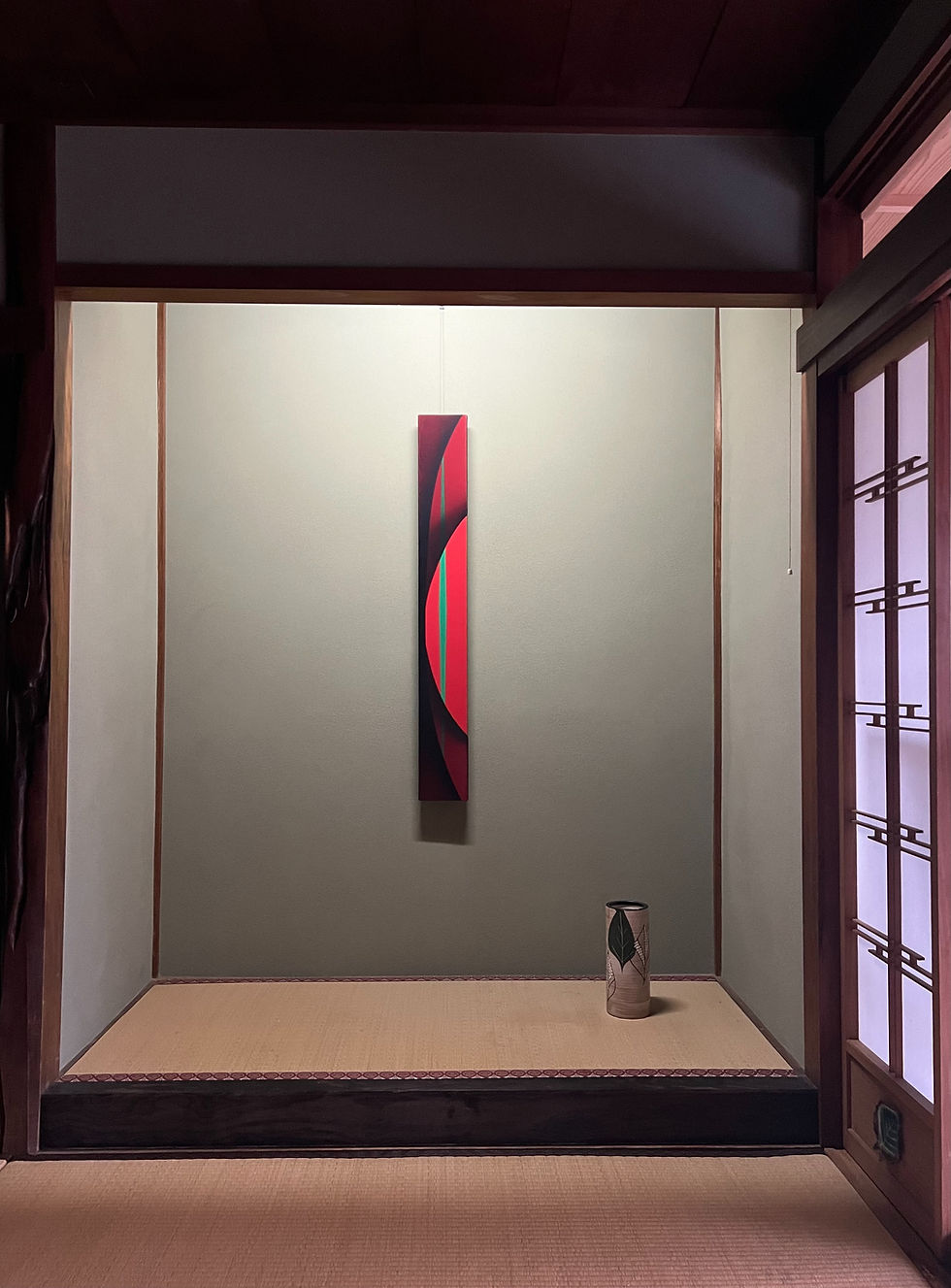
The Tokonoma in the Japanese House
In the Japanese house, the tokonoma is a recessed rectangular alcove integrated into the main reception room. Slightly raised above the tatami floor, it is defined by a dark wooden threshold or frame that marks the boundary between the ordinary floor and the noble space. Its inner surface is finished either with a tatami mat or with a polished wooden board. The side walls and back wall are generally coated in a light plaster. Among the most remarkable elements of the whole is the 床柱 (toko-bashira), the vertical pillar that borders the alcove. Chosen from a fine piece of wood, and sometimes left almost raw in order to preserve its grain, knots, or slight irregularities, it serves not only a structural purpose: it forms a major visual axis, giving the tokonoma its composure, its vertical emphasis, and an essential part of its presence.
The Meaning of 床の間: Toko and Ma
This architectural form finds a direct echo in the word 床の間 itself, whose philological richness helps illuminate its deeper logic. The character 床 (toko) originally refers to a raised platform, a place intended for rest or honor. From the Nara period onward (8th century), toko came to designate a slightly elevated area where one sat or slept, clearly set apart from the ordinary ground. It therefore carries the idea of elevation, both physical and symbolic. In monastic cells, a board could be placed against the wall to hold ritual objects, while Buddhist paintings were hung above it. With the development of the tea ceremony, the tokonoma gradually became a space devoted to aesthetic and spiritual appreciation.
The character 間 (ma) is historically composed of 門 (gate, opening) and 月 (moon); its older form evokes moonlight passing through an opening. Ma signifies interval: the illuminated in-between, the breathing space between two limits. It does not describe a neutral emptiness, but an active interval that gives structure to physical space, time, and human relations alike. The same character appears in fundamental terms such as 空間 (kūkan, space), 時間 (jikan, time), and 人間 (ningen, human being).
Why the Tokonoma Still Matters for Contemporary Art
In the Japanese house, the tokonoma is never stepped into; it remains a protected space, set apart for contemplation. Its function is precise: it marks the most honored area of the room, where a painting or calligraphy is displayed, sometimes accompanied by a floral arrangement or a chosen object, such as a ceramic vessel or a stone. The tokonoma thus embodies a discreet spatial hierarchy and an aesthetic of restraint. Yet for that very reason, it also continues to speak powerfully to contemporary art, offering a setting in which presence, scale, material, and attention may be experienced with unusual clarity.


Comments